
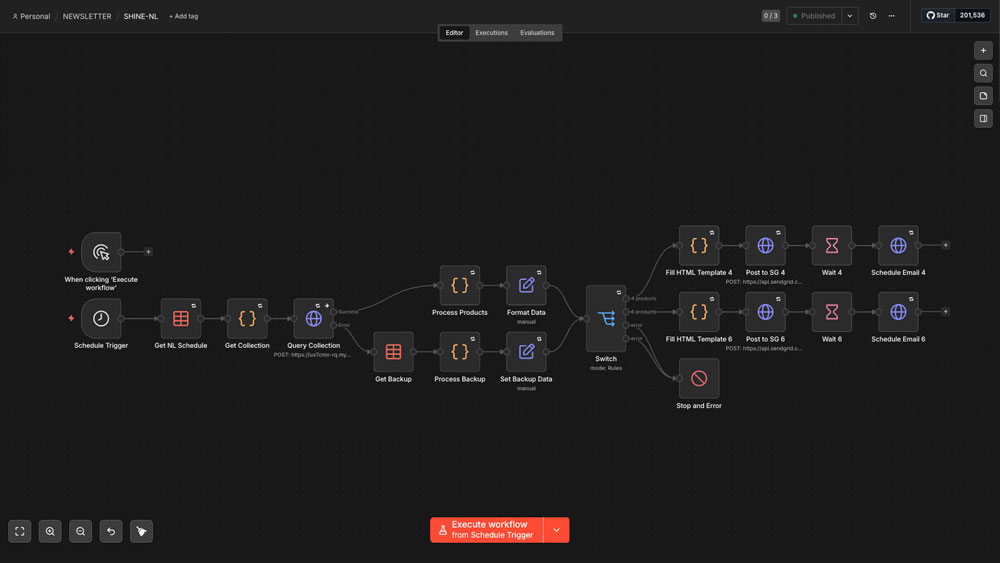
An automated product newsletter.
Pulls products from your store on a schedule, follows a theme calendar and content pillars built for your business, and sends to your customer list without anyone pressing send.
AI automation for small business
The repetitive work runs itself. You get back to what grows the business.
Automated newsletters, blog publishing, follow-up, and lead generation, built in your accounts at a fixed price, with 90 days of service included.
If it repeats, runs on a schedule, or only happens when somebody remembers, it's a candidate. Fixed scope and fixed price, whichever one it turns out to be.
Here are a few ways that can take shape.
Pulls products from your store on a schedule, follows a theme calendar and content pillars built for your business, and sends to your customer list without anyone pressing send.
Researches, drafts in your business voice, and publishes to your store or site on schedule. I can also build it as an interactive tool you drive yourself, with your hand in the research and the editing.
New inquiries answered, quotes chased, happy customers asked for a review. Standard business automation, built around your workflow.
Call answering and routing built on voice AI platforms. Setup and integration, not enterprise telephony.
Bring your processes, reference material, decisions, and recurring jobs into one place. Start with one useful area, then add dedicated AI tools for leads, research, communication, or internal questions as the business needs them. You own the system and can keep refining it.
Two examples below are systems I have built for local clients.
A client runs an automated newsletter: it pulls products from their store and sends to their customer list on a schedule. Nobody touches it. Here is what the email platform reported.
| Metric | One send | Two months | Industry Average |
|---|---|---|---|
| Opened | 48.82% | 64.83% | 36.5% |
| Clicked | 18.52% | 13.05% | 1.4% |
| Bounced | 1.68% | 0.03% | — |
| Marked spam | 0.17% | 0.06% | — |
Average open rate and click-through rate for email campaigns: Forbes Advisor email marketing statistics.
Opens are attention. Clicks are intent, and intent is the number that pays. This went to a couple thousand of their own customers, not a purchased list. A small, engaged list outperforms a broad average, which is exactly the point: the list you already own is the cheapest conversion channel in the building.
Yes it can. Like the one I built for a real estate team working Buncombe County.
The system reads public records and market signals, scores properties for equity and likelihood to sell, and hands over a ranked list of likely sellers. The point isn't the list. The point is when you get it.
The system finds. You decide. Choosing who to contact and when stays a human decision made outside the system. Public records only, and a permanent do-not-contact list is honored.
The same approach adapts to any business whose next customers leave a public trace.
I have worked with businesses sitting on ten thousand customer email addresses who had never once emailed them. Nobody decided against it. Either there was no time, or nobody there had done it before, so it never came up.
That isn't unimportant work. It's the part that brings the money in: the follow-up, the reactivation, the repeat sale. It just never had anybody's name on it.
Maybe none of that is you. If your follow-up never slips, your list never goes stale, and nothing worth doing is going undone, you don't need me.
Ask: “If business suddenly got busier, what would break first?” That’s usually where automation should start.
The one at the limit is where automation pays for itself. The one at the bottom is usually where the money is.
The best first automation is a repeatable task that takes up time, creates mistakes, or slows down customers and staff. Fixing one of those problems can save hours every week.
Sometimes the answer is not automation. A process may just need a simpler form, clearer steps, or a better tool you already have. If you can fix it yourself in an afternoon, I’ll tell you. If it is not worth fixing, I’ll tell you that too.
The free report gives you a quick outside view. The half-day assessment goes deeper: we map how the work moves through your business, find the biggest hold-ups, and give you a clear order for what to fix first.
Sometimes the problem is not one missed follow-up or one newsletter. The business information and working processes are scattered across people. Some of it sits in inboxes or folders. Some lives only in memory.
We can start by putting one part of that in order, then build from there: a reliable place for the business to keep what it knows, and focused AI tools that can use it. The point is not to give you a generic assistant. It is to build something around how your business actually runs.
I use a system like this in my own business. This is a larger build, scoped after the assessment.
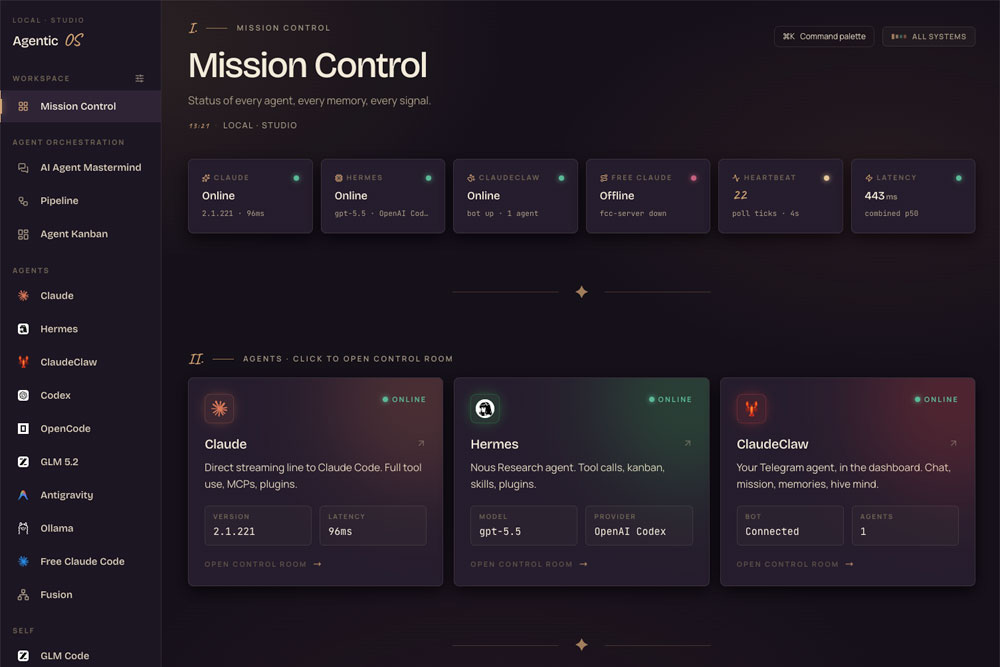
I set up the system in your accounts, on a VPS in your name. You pay the software and hosting bills directly. You own the workflows and data from the start. The whole system is yours.
Every build includes 90 days of service. During that window, I correct errors, check the output, and fix issues within the agreed build. Then I hand it over. It keeps running without me.
After 90 days, repairs, changes, extensions, and additional support are separate paid work. You do not need a monthly maintenance plan to keep using what you own.
The VPS, software, workflows, and data stay in your name.
I correct errors, check the output, and maintain the agreed build.
After 90 days, help is paid work when you need it.
Start here
AI looks at your business from the outside and reports what a business like yours could use: automation, tools, and what to do first. Findings you can act on with or without me.
FreeOutside-in. No access to your systems required.The assessment
A half day inside your business until I understand how it actually works: the workflows, the pain points, the bottlenecks. You get the map and the order to fix things in.
$1,000The build
Fixed scope, fixed price, agreed in writing before anything begins. Simple builds start at $1,500. Larger systems are scoped after the assessment. Training sessions and ninety days of service are included.
Starting at $1,500Monthly payments, not a monthly contract. Fifty percent is due at the start. The remaining balance can be paid on a schedule we choose together, and delivery paces to payment.
Ninety days of service, included. I correct errors, check the output, and fix issues within the agreed build. After 90 days, the system remains yours and continues to run. Repairs, changes, extensions, and additional support are scoped and paid separately.
I am based in Asheville, NC and work with businesses across Western North Carolina with remote engagements when they fit.
This is for owner-operated businesses that want defined, fixed-scope projects. It is not for enterprise-scale organizations, AI systems inside regulated data environments (HIPAA, SOC 2), bookkeeping or payroll. Voice AI setup is in scope; enterprise telephony is not.
AI looks at your business from the outside and reports what tools or automations a business like yours could use, and what to do first. You get findings you can act on, with me or without me.